Best Kitchen Knife Steel? A Custom Knife Maker Explains Why He Loves AEB-L
Published: Sat Apr 13 2024 00:00:00 GMT+0000 (Coordinated Universal Time)
"I love AEB-L steel. It sharpens as easily as higher carbon steels but holds the edge far longer. It is very tough- which allows me to grind my knives super-thin like big razor blades with a handle. They cut better and stay sharp for a long time."
Buying a new knife can be exciting, but it also brings a lot of anxiety—There are a lot of scams out there and no one wants to get ripped off. I recommend buying local when possible as you'll get to see and touch the product ahead of time. If you're in the Sacramento area, I'll even let you take a knife home to test it. Also, look for knife reviews and testimonials. Beyond that, when picking a knife, the steel it's made from deserves a spotlight, right alongside edge geometry and heat treatment which I'll cover here and in future articles.
Today, let's dive into why AEB-L steel is my go-to choice. Everyone loves sharp knife. I use AEB-L because it's easy to get sharp and stays sharp for a longer than other steels in the same price range. It's also stainless, which makes maintenance a whole lot easier as you don't have to worry (as much) about rust.
Sharpness vs. Strength: What Hardness and Toughness mean in the knife world
Alright, let's unpack two key terms when it comes to knife steel: hardness and toughness. Think of them like this:

Hardness: Imagine a ceramic dinner plate. It's incredibly hard, you can cut food on it with a steak knife and not leave a mark. This hardness translates to a knife steel that can take a wicked sharp edge. However, just like a ceramic plate can shatter if you drop it, very hard knife steels can be a bit delicate. Super-hard steels need special care and should never be used on bones or other hard objects as they tend to chip easily.
Toughness: Now, picture an aluminum can. It can bend and dent without breaking easily. That's toughness in knife steel. AEB-L is a great example of this. It's tough enough to take on everyday kitchen tasks like chopping tough root vegetables or even some light bone work without complaining.

The beauty of AEB-L is that it finds the sweet spot between these two properties. It gets sharp like a dream and holds that edge for a good amount of time, all while being tough enough to tackle most kitchen adventures with ease.
It's also very forgiving. Knick a bone, tap a plate or countertop, and instead of chipping it will bend. A couple quick passes on a knife steel and you're back in business.
That's Good and All but What Does it Mean in Real Life?
Good question! It means I am able grind my blades very thin. When it comes to kitchen knives thinner is almost always better. Yeah- almost is in bold. Because it's not always better. It's only better when done with the right steel and the right heat treatment.
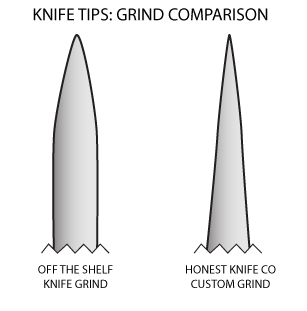
Look at image 1 above. On the left is the standard grind that you'll find on most off-the-shelf knives. It's sharp at the very tip. But due to the nature of the steel it's made from, it requires a lot of steel right behind the edge for support.
On the right is an illustration of one of my knives. Because of the steel use (AEB-L) and the way it's been heat treated, I can grind my knives much thinner. The steel is hard and tough so it doesn't need the extra bulk to support the fine edge.
It doesn't take a rocket scientist to see which knife will cut better. Which one would you rather use?
Thin Knives Stay Sharp Longer
The benefits of thin-edge geometry is more than just cutting performance. Thin knives stay sharper longer. Here's why...

In Image 2 above, the same knives are shown but now they've been used a bit and have lost some of their edge. As the edge wears away it's pretty clear that the off-the-shelf knife looks more blunt than the thin ground knife. The off-the-shelf knife loses performance at a much faster rate than the thin-edged knife.
That's another big win for AEB-L. Its ability to be ground thin is a direct correlation to its toughness, it doesn't need all the bulk required by the other knife.
Conclusion
AEB-L steel stands out as a compelling choice for custom knives. It offers a remarkable balance between toughness, sharpness, and ease of maintenance. Whether you're a professional or an aspiring home chef, AEB-L provides exceptional performance.
The ability to achieve a keen edge with minimal effort makes it user-friendly for both experienced knife users and beginners alike. Its stainless properties further enhance its practicality, ensuring a low-maintenance blade that resists rust and stains.
In the hands of a skilled knife maker, AEB-L transforms into a beautiful and functional tool. This steel allows for the creation of custom knives that are not only aesthetically pleasing but also deliver exceptional cutting performance and long-lasting value.
If you're looking for a custom knife that offers a great balance of performance and ease of use, consider AEB-L steel. Contact me today to discuss your custom knife project and see how AEB-L can be the perfect choice for your dream blade.
Ready to experience the difference?
The books are closed for individual orders, but the next batch of precision-crafted blades is in the works.
Join The Waitlist