Hand Forged
vs
Stock Removal
Why tradition doesn't always equal performance on the cutting board.
Science: Romantic Notions vs Performance
If you have watched Forged in Fire or seen videos of a blacksmith hammering glowing red steel on an anvil, you probably have a romantic image of how a knife is made.
It is a beautiful, ancient art form. Because of that, many of my customers come to me specifically searching for “hand forged kitchen knives.”
But when they visit my shop here in Rocklin, CA, they are often surprised to see that I don’t own a forge or an anvil. I am a “Stock Removal” maker.
I want to be honest about why. I don’t use stock removal because it is easier—grinding hardened steel is incredibly difficult work. I use stock removal because, for the high-performance stainless steels I use, it produces a superior kitchen knife.
The Myth of “The Forged Edge”
There is an old myth that forging “packs the molecules” of the steel closer together, making it denser and stronger.
In 2026, metallurgical science tells us this isn’t true. Steel density is constant; you cannot pack the atoms tighter by hitting them with a hammer.
In the past, forging was necessary because steel was inconsistent. You had to hammer it to refine the grain structure. But today, I buy precision-rolled sheets of high-tech steel directly from American and European mills. This steel arrives with a near-perfect, uniform grain structure.
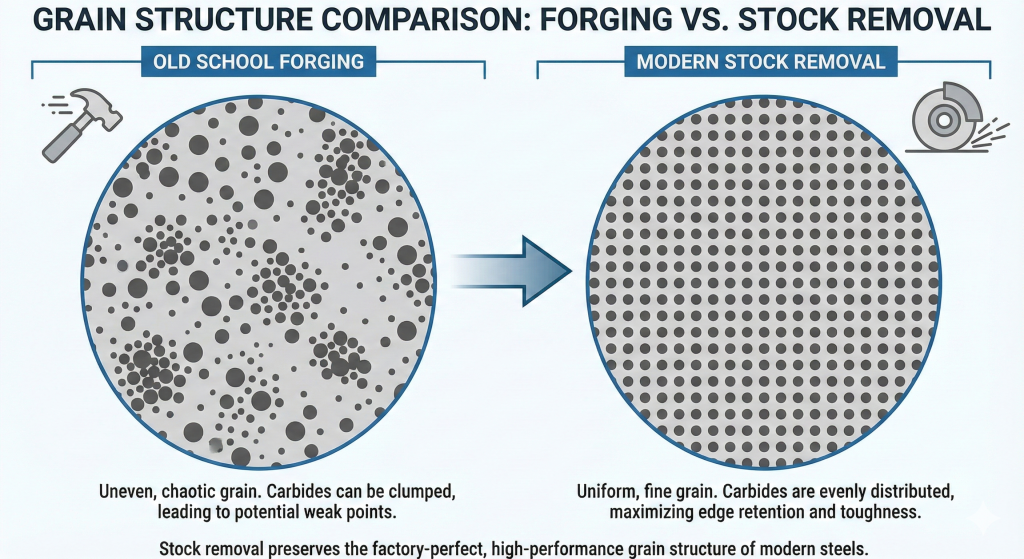
If I were to heat that perfect steel up to 2,000 degrees and smash it with a hammer, I wouldn’t be making it better—I would be introducing variables that could ruin that perfect factory structure.
Why I Choose Stock Removal for Your Kitchen Knife
Stock removal is the process of taking a flat bar of steel and grinding away everything that isn’t a knife. It is a process of subtraction rather than manipulation.
Here is why this matters for the knife sitting on your cutting board:
1. Precision Geometry
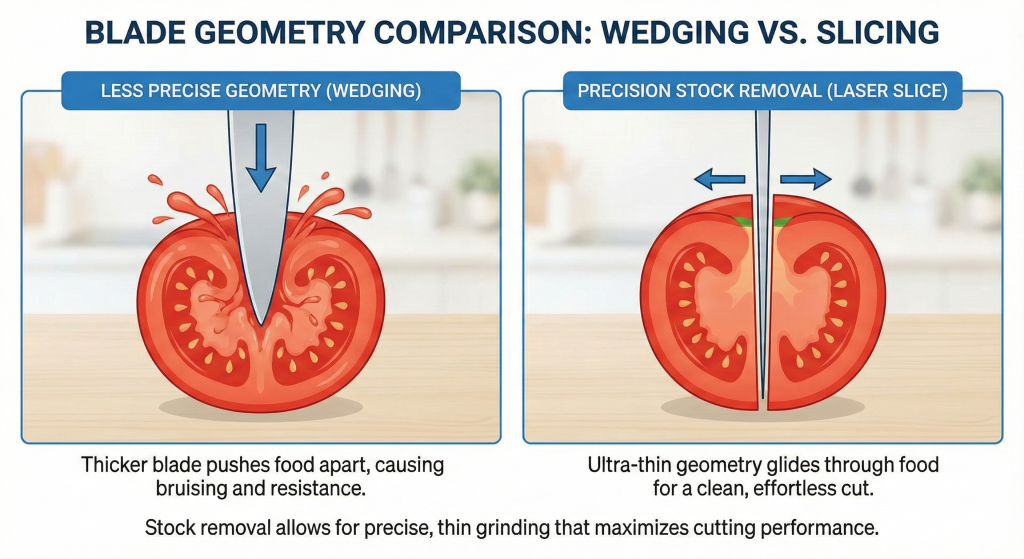
A kitchen knife needs to be thin. Incredibly thin. By grinding the steel on precision equipment, I can control the taper and thickness to within a thousandth of an inch. This ensures your custom Gyuto or Santoku glides through a tomato rather than wedging it apart.
2. Preserving the Stainless Super-Steels
I specialize in steels like AEB-L and Magnacut. These are complex super-steels capable of taking a shockingly sharp edge. However, these demanding alloys do not like the thermal shock of a hammer. They perform best when we respect their chemistry, cut them precisely, and focus 100% of our energy on the Heat Treatment.
3. The Heat Treat is the Heart
Whether a knife is hand forged or ground from stock, the soul of the blade is in the heat treatment. This is where the hardness and toughness are locked in. Because I don’t spend hours hammering the shape, I can spend more time perfecting the thermal cycling, cryo-treatment, and tempering of the blade.
The Verdict?
I have huge respect for blacksmiths. It is an incredible skill. If you want a rustic, carbon steel blade that looks like it came from the 1800s, a hand forged knife is a great choice.
But if you are looking for a high-performance custom kitchen knife that is laser-straight, incredibly thin behind the edge, and maximizes the absolute potential of modern metallurgy, Stock Removal is the winner.
That is why I build my knives the way I do. It’s not about the romance of the hammer; it’s about the performance of the cut.
Ready to feel the difference?
Browse our archive of past custom builds to see what goes into each batch.
View The Archive